MemoHoney Official Website › MemoHoney Ingredients
MemoHoney IngredientsMemoHoney Ingredients: The Full Label, Line by Line
Each MemoHoney capsule lists seven active ingredients, with no proprietary blend.
L-arginine 200 mg, L-arginine AKG 2:1 200 mg, L-citrulline HCl 100 mg, L-citrulline malate 100 mg, beta-alanine 40 mg, niacin 7.5 mg NE and calcium 18 mg.
Written by the MemoHoney Team at Memohoeney · Expert review: Dr. Mary Cunningham, neuropsychologist · Revised
Five of these seven come out of nitric-oxide and sports-nutrition research, and the label prints them at a fortieth to a sixtieth of the trial amounts. That gap is the most useful thing to know about this bottle, and it is the reason the trial amounts are printed beside every line.
The MemoHoney Supplement Facts panel, as the bottle prints it
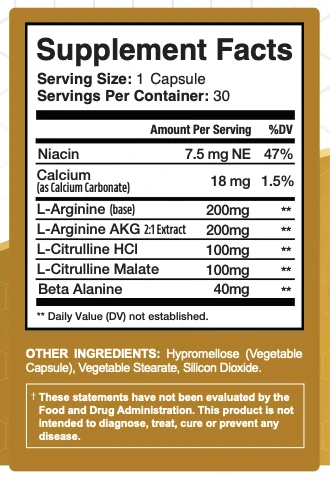
The seller's own page shows the whole bottle wrap: directions on the left, the front in the middle and this panel on the right. Serving size is one capsule and there are 30 servings to the container.
The seller's ingredient copy and its INSIDE MEMOHONEY graphic name six ingredients. The panel prints seven, because it adds calcium, as calcium carbonate, at 18 mg. The label is the regulated statement on the container you receive, so where the two disagree this website follows the label.
| Per capsule | Amount | % DV |
|---|---|---|
| Niacin | 7.5 mg NE | 47% |
| Calcium (as Calcium Carbonate) | 18 mg | 1.5% |
| L-Arginine (base) | 200 mg | †† |
| L-Arginine AKG 2:1 Extract | 200 mg | †† |
| L-Citrulline HCl | 100 mg | †† |
| L-Citrulline Malate | 100 mg | †† |
| Beta Alanine | 40 mg | †† |
†† Daily Value not established. Also in the capsule: hypromellose (the vegetable shell), vegetable stearate and silicon dioxide. Read off the bottle wrap on the seller's page on 21 September 2026.
What each MemoHoney ingredient is, and where it has been studied
Seven cards, one per line on the panel. The pill beside each name is the label's amount; the amount in the card is a trial's.
L-Arginine
Amino acidLabel: 200 mg (as the base)The molecule an enzyme called nitric oxide synthase converts directly into nitric oxide, the short-lived gas that tells the muscle around a blood vessel to relax.
Research field: blood pressure, exercise capacity and vascular function. What it used: Supplement trials work in grams; a labelled-meal study tracked how much of a single dietary dose survives to become nitric oxide. a stable-isotope study of dietary arginine.
L-Arginine AKG 2:1 Extract
Amino acid saltLabel: 200 mgTwo parts arginine bound to one part alpha-ketoglutarate. The pairing is sold on the idea that the salt reaches the blood in better shape than plain arginine does.
Research field: resistance training and blood flow in trained young men. What it used: 4 g three times a day, 12 g in total, in the pharmacokinetic trial. the arginine AKG pharmacokinetic trial.
L-Citrulline HCl
Amino acid saltLabel: 100 mgCitrulline slips past the gut and liver enzymes that strip out most oral arginine, and the kidney then converts it to arginine. Gram for gram it raises blood arginine more reliably than arginine itself.
Research field: cerebral blood flow during hard interval exercise. What it used: 8.8 g a day for five days in the cerebrovascular trial. the citrulline cerebrovascular trial.
L-Citrulline Malate
Amino acid saltLabel: 100 mgThe same citrulline, bound to malic acid instead of hydrochloride. This is the form most of the sports literature actually used.
Research field: sprint repeatability, resistance training, and one older-adult trial. What it used: 8 g a day for three days; 8 g and 12 g compared head to head acutely. a three-day citrulline malate trial.
Niacin (Vitamin B3)
VitaminLabel: 7.5 mg NE, 47% DVThe body turns it into NAD and NADP, the two electron shuttles of energy metabolism, which a neuron runs on exactly as every other cell does. Run short badly enough and the result is pellagra, whose third classical symptom is dementia.
Research field: a long-running dietary cohort, not a randomised trial. What it used: Dietary intakes in the low tens of milligrams a day; the US upper intake level for supplemental niacin is 35 mg. the Chicago Health and Aging Project analysis.
Beta-Alanine
Amino acidLabel: 40 mgThe slower half of carnosine, a two-amino-acid molecule that buffers acid inside muscle and is also present in brain tissue. Supplying beta-alanine is what raises carnosine; the other half is never in short supply.
Research field: exercise capacity, plus one small brain-imaging trial in older adults. What it used: 2.4 g a day in the imaging trial; 3.2 to 6.4 g a day in the sports meta-analysis. the beta-alanine brain-imaging trial.
Calcium (as Calcium Carbonate)
MineralLabel: 18 mg, 1.5% DVPrinted on the panel and named nowhere in the seller's advertising. Calcium carbonate is the ordinary chalk-derived form, and in a capsule this size it adds weight rather than a dose.
Research field: nowhere relevant to memory. What the panel says: the panel itself puts 18 mg at 1.5% of the Daily Value.
The MemoHoney label beside the published trials
The quarantine section. The comparison is made once, here, and referenced everywhere else.
Read down the two right-hand columns together and the pattern is plain: the label prints milligrams, and the trials behind five of these names used grams, in single-ingredient studies of people doing hard exercise. 640 mg of amino acids is what one capsule carries, and it is less than any one of those trials gave of a single ingredient.
Niacin is the exception worth stating plainly. Its useful range is milligrams, the label prints 7.5 mg NE, 47% of the Daily Value, and the US tolerable upper intake level is 35 mg a day from supplements. It is the one ingredient here printed at the kind of amount it is actually used at.
The panel on this page was read off the seller's own image on 21 September 2026. The bottle in your hand is the one that counts: if its panel differs, tell the order desk, quote lot MEM-26/ME-4192 and certificate reference MEM-4192-26-ME, and write to the website inbox in the site footer so this page can be corrected.
Why two molecules appear on the MemoHoney label in four forms
Arginine and citrulline are two steps of the same cycle, and both appear here twice: 400 mg of arginine across two lines and 200 mg of citrulline across two more. That looks like padding until you know what each form was made for.
Arginine is the direct substrate: the enzyme nitric oxide synthase acts on arginine and nothing else. The problem is getting it there. A large share of an oral dose is broken down by arginase in the gut wall and the liver before it reaches the general circulation, which is the finding the stable-isotope work exists to quantify.
Citrulline is the workaround. It passes the gut and liver largely untouched and the kidney converts it to arginine, so gram for gram it raises plasma arginine more reliably than arginine itself. A human availability study put numbers on that, and a 2026 quantitative characterisation traced the conversion in detail.
L-Arginine (base) and L-Arginine AKG 2:1, 200 mg each
The free amino acid and a salt of it bound to alpha-ketoglutarate, two parts to one. The salt comes from the pre-workout shelf and is sold on better survival to the blood. Its pharmacokinetic trial gave 12 g a day; a 3 g single dose before one session and seven days at 12 g a day both failed to move the performance measures they were looking at.
L-Citrulline HCl and L-Citrulline Malate, 100 mg each
The hydrochloride salt and the malate salt of the same molecule. Malate is the form most of the sports literature used, including a head-to-head comparison of 8 g and 12 g and an older-adult trial at 3 g a day alongside six weeks of supervised exercise. The malic acid half is a metabolic intermediate rather than an inert carrier, which is the argument for it.
The honest summary is that the four forms cover the same pathway from two directions, and that the head-to-head evidence for the salts adding anything over the plain amino acids is thin. One trial gave citrulline and arginine together and found the combination raised plasma levels faster than either alone, which is the nearest thing to a rationale for a label that carries both.
What else the MemoHoney label says, and what it leaves out
The panel is more complete than the advertising around it. Three things on the label are worth knowing before the bottle arrives, and one is still missing.
- An Other Ingredients line. Hypromellose (vegetable capsule), vegetable stearate, silicon dioxide. Hypromellose is a plant cellulose, so the shell is not gelatin, which is what the vegetarian emblem says too
- A serving size. One capsule, 30 servings to the container, with a milligram figure for every active line
- Where it is made. The label reads: Manufactured in the USA with globally sourced ingredients.
- Still missing: an allergen statement. Gluten-free and dairy-free emblems appear with the product, which is a formulation claim rather than a tested figure. Anyone with coeliac disease should write for the tested parts-per-million
None of that is unusual and none of it is unlawful. It means the useful comparison between this bottle and a competitor's can be made line by line, in milligrams, which is more than most labels in this category allow.
MemoHoney ingredient questions
How many ingredients are in MemoHoney?
Seven active lines on the Supplement Facts panel: L-Arginine (base) 200 mg, L-Arginine AKG 2:1 Extract 200 mg, L-Citrulline HCl 100 mg, L-Citrulline Malate 100 mg, Beta Alanine 40 mg, Niacin 7.5 mg NE and Calcium (as calcium carbonate) 18 mg. The seller's advertising names six of them and leaves out the calcium.
Does MemoHoney use a proprietary blend?
No. A proprietary blend gives one total for a group of ingredients and hides the split between them. This panel prints an amount for every line, so the split is visible in full.
How much L-Citrulline is in MemoHoney?
200 mg a capsule: 100 mg of L-citrulline HCl and 100 mg of L-citrulline malate. The trial amounts for citrulline run from 3 g a day in an older-adult study to 8.8 g a day in the cerebrovascular trial.
Is there caffeine in MemoHoney?
No stimulant appears on the panel. The seven active lines are five amino acid forms, niacin and calcium.
Are the MemoHoney capsules vegetarian?
The label lists the capsule as hypromellose, a plant cellulose rather than gelatin, and a vegetarian emblem appears with the product. The other two added ingredients are vegetable stearate and silicon dioxide.
Why does a memory supplement contain sports-nutrition ingredients?
Because the argument is circulatory. Arginine and citrulline raise nitric oxide, nitric oxide widens blood vessels, and a widened vessel carries more blood. One 2025 trial measured cerebral blood flow during sprint intervals at 8.8 g a day. The step from that to a name arriving faster has not been tested, and not at the 200 mg this label prints.
Sources for the MemoHoney ingredient list
- Am J Clin Nutr (2013) 97(5):972-9: “Kinetics of the utilization of dietary arginine for nitric oxide and urea synthesis: insight into the arginine-nitric oxide metabolic system in humans”, by Mariotti F, Petzke KJ, Bonnet D, et al, PubMed 23535108.
- Nutrients (2019) 11(7):1679: “The Effects of Oral l-Arginine and l-Citrulline Supplementation on Blood Pressure”, by Khalaf D, Krüger M, Wehland M, et al, PubMed 31336573.
- Nutrition (2006) 22(9):872-81: “Pharmacokinetics, safety, and effects on exercise performance of L-arginine alpha-ketoglutarate in trained adult men”, by Campbell B, Roberts M, Kerksick C, et al, PubMed 16928472.
- J Int Soc Sports Nutr (2012) 9(1):17: “Acute L-arginine alpha ketoglutarate supplementation fails to improve muscular performance in resistance trained and untrained men”, by Wax B, Kavazis AN, Webb HE, et al, PubMed 22510253.
- Int J Sport Nutr Exerc Metab (2011) 21(4):291-9: “Effects of 7 days of arginine-alpha-ketoglutarate supplementation on blood flow, plasma L-arginine, nitric oxide metabolites, and asymmetric dimethyl arginine after resistance exercise”, by Willoughby DS, Boucher T, Reid J, et al, PubMed 21813912.
- J Exerc Sci Fit (2025) 23(3):222-228: “The effects of L-citrulline supplementation on cerebrovascular function during sprint interval training in taekwondo athletes”, by Li A, Li H, Chen J, PubMed 40474881.
- Am J Physiol Gastrointest Liver Physiol (2007) 293(5):G1061-7: “Manipulation of citrulline availability in humans”, by Rougé C, Des Robert C, Robins A, et al, PubMed 17901164.
- Front Pharmacol (2026) 17:1889835: “Quantitative characterization of L-citrulline as a precursor of L-arginine in rats: pharmacokinetic basis for nitric oxide-mediated effects”, by Song S, Thapa SK, Upadhyay M, et al, PubMed 42755674.
- Eur J Sport Sci (2024) 24(6):758-765: “Effects of 3 days of citrulline malate supplementation on short-duration repeated sprint running performance in male team sport athletes”, by Faria VS, Egan B, PubMed 38874989.
- J Funct Morphol Kinesiol (2026) 11(1): “The Comparative Effect of Acute Moderate- and High-Dose Citrulline Malate on Resistance Exercise Performance in Trained Individuals: A Double-Blind Randomised Controlled Pilot Trial”, by Gough LA, Tan R, Bailey SJ, et al, PubMed 41900522.
- Clin Nutr ESPEN (2026) 74:103356: “Short-term citrulline malate supplementation enhances lower-limb function in physically active older women: A pilot randomized controlled trial”, by Ramos-Hernández R, Pascual-Fernández J, Álvarez-Pardo S, et al, PubMed 42162613.
- Biochem Biophys Res Commun (2014) 454(1):53-7: “Oral supplementation with a combination of L-citrulline and L-arginine rapidly increases plasma L-arginine concentration and enhances NO bioavailability”, by Morita M, Hayashi T, Ochiai M, et al, PubMed 25445598.
- J Neurol Neurosurg Psychiatry (2004) 75(8):1093-9: “Dietary niacin and the risk of incident Alzheimer's disease and of cognitive decline”, by Morris MC, Evans DA, Bienias JL, et al, PubMed 15258207.
- Nutr Rev (2017) 75(6):471-490: “Definition of a tolerable upper intake level of niacin: a systematic review and meta-analysis of the dose-dependent effects of nicotinamide and nicotinic acid supplementation”, by Minto C, Vecchio MG, Lamprecht M, et al, PubMed 28541582.
- Exp Gerontol (2024) 194:112513: “β-Alanine supplementation improves fractional anisotropy scores in the hippocampus and amygdala in 60-80-year-old men and women”, by Ostfeld I, Zamir A, Ben-Zeev T, et al, PubMed 38971131.
- Br J Sports Med (2017) 51(8):658-669: “β-alanine supplementation to improve exercise capacity and performance: a systematic review and meta-analysis”, by Saunders B, Elliott-Sale K, Artioli GG, et al, PubMed 27797728.
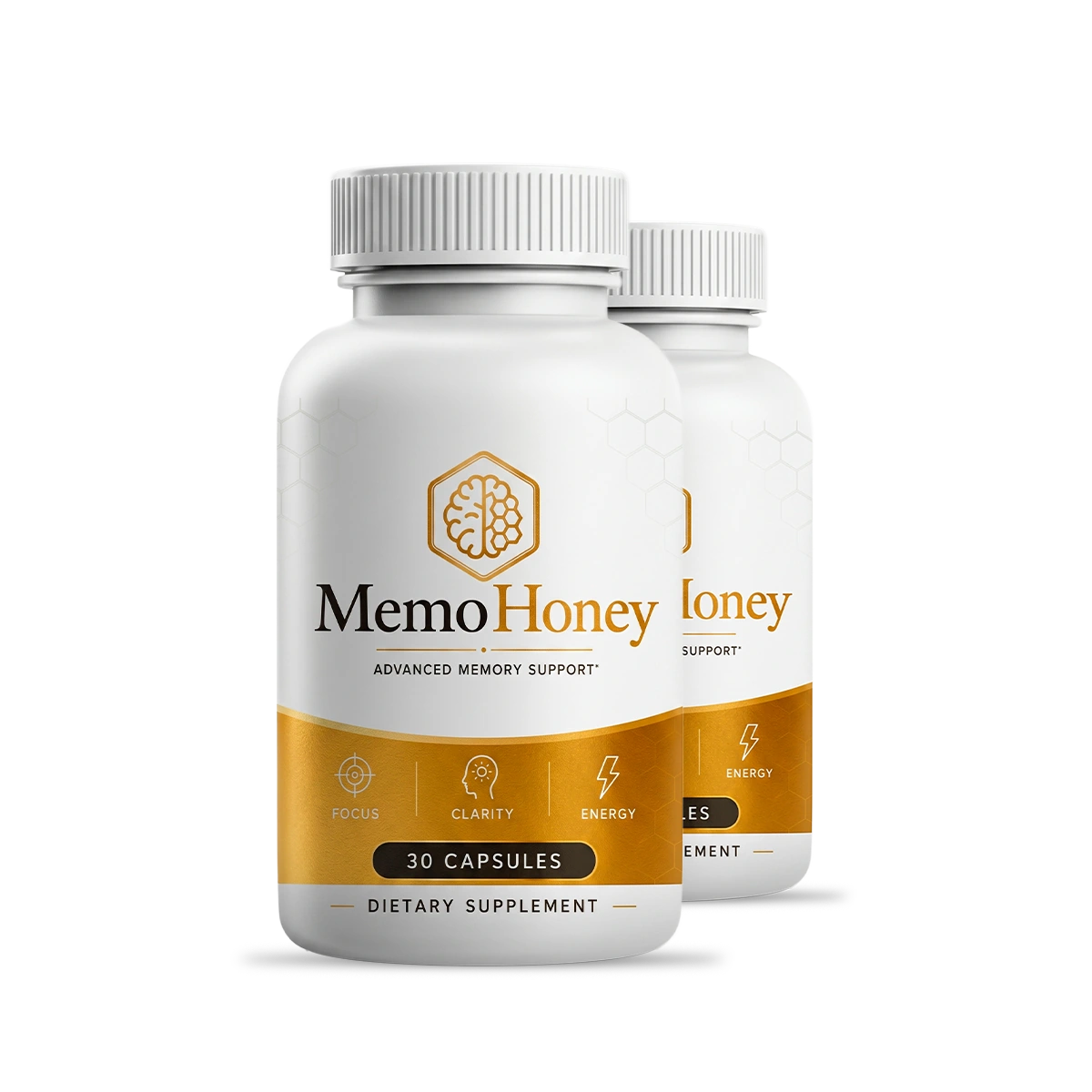
Order MemoHoney with the ingredient list in front of you
Seven lines on the panel, the trial amounts beside them, and 60 days from purchase to decide whether the bottle earns its place.
Two bottles $158 · six bottles $294 · 60-day money-back guarantee
Order MemoHoney From This CounterLot MEM-26/ME-4192 · one a morning, 30 to a bottle · ships from the United States