MemoHoney Official Website › Articles › Reading the panel
Reading the panelSeven Label Lines Beat Six Advertising Names on MemoHoney
The Supplement Facts panel names seven active lines, while the advertising names six. When the two do not match exactly, the panel is the better source for what one capsule says it contains.
The bottle contains two different lists
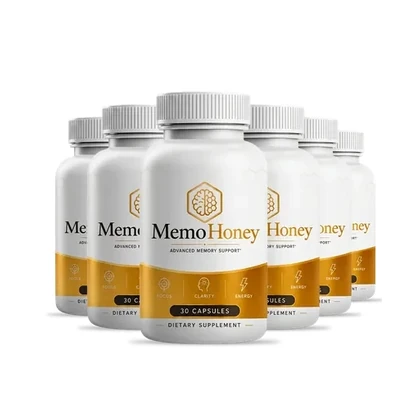
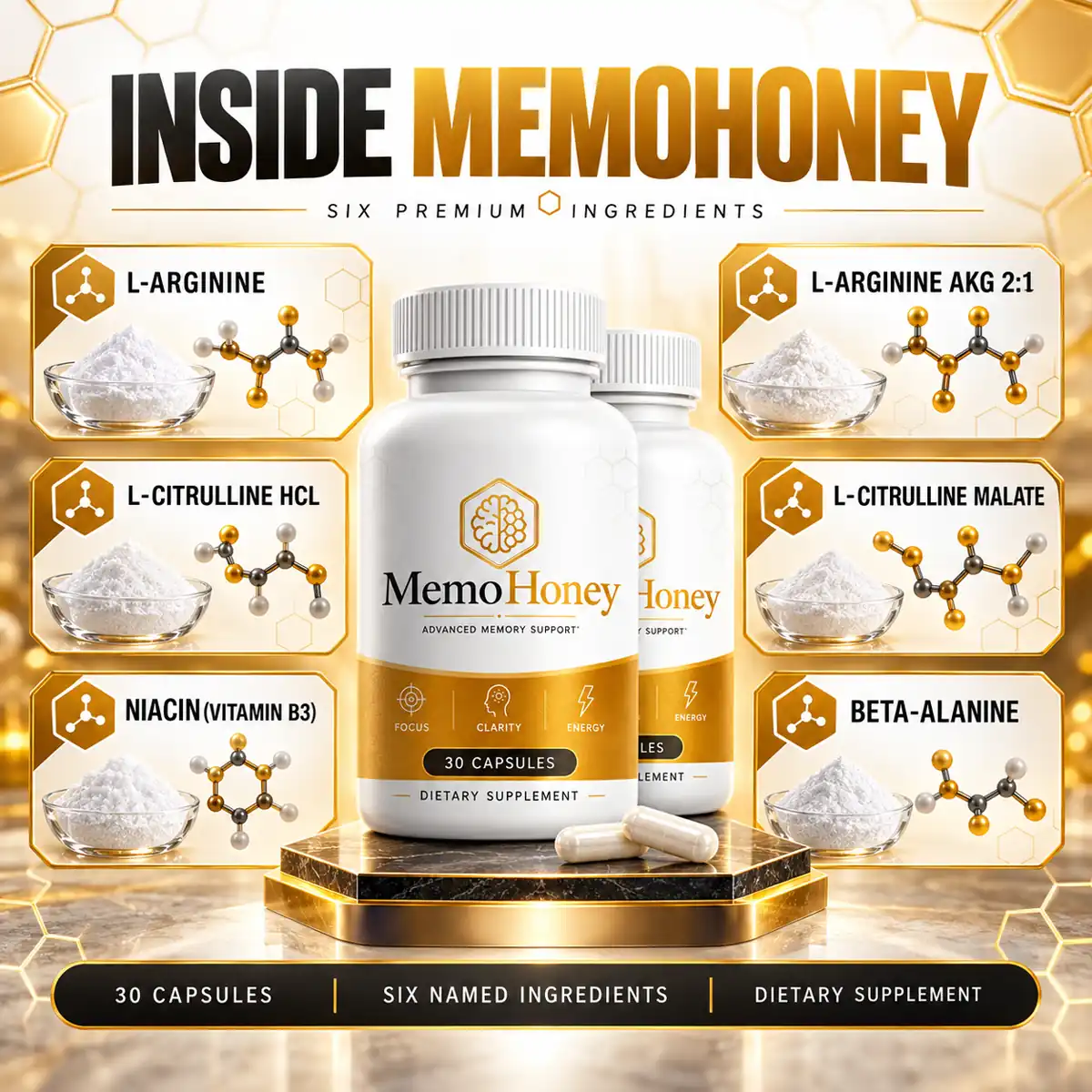
The MemoHoney information supplied for this site contains a useful mismatch. The seller’s advertising names six ingredients, while the Supplement Facts panel on the bottle wrap prints seven active lines. The extra line is calcium as calcium carbonate, 18 mg, 1.5% of the Daily Value. That does not make the advertising list false; it means the panel is the more complete statement of what is in one capsule.
A buyer can use this difference as a general label-reading rule. When prose, a hero image, a tile graphic, and a regulated panel are not identical, do not average them into a new version. Keep the more detailed, product-specific panel in front of you. It is the only supplied source here that names a serving, the number of servings, and an amount for every active line.
The panel says one capsule is one serving and there are 30 servings per container. That turns the product from a broad promise into a defined daily unit. It still does not establish a clinical outcome, but it gives a reader the numbers needed to ask a much better question about the formula than an advertising phrase can answer.
| Panel item | Printed per capsule | What it changes |
|---|---|---|
| Niacin | 7.5 mg NE, 47% DV | A nutritional amount with a stated Daily Value |
| Calcium carbonate | 18 mg, 1.5% DV | A seventh active line absent from advertising prose |
| Two arginine forms | 400 mg total | A named, measurable amount—not a study result |
| Two citrulline forms | 200 mg total | A named, measurable amount—not a study result |
| Beta Alanine | 40 mg | A disclosed amount to compare carefully with research |
The panel supplies quantities. It does not turn a single-ingredient study into a trial of this finished product.
Read the seven lines before reading the story
The seven panel lines are niacin 7.5 mg NE, calcium 18 mg, L-Arginine 200 mg, L-Arginine AKG 2:1 Extract 200 mg, L-Citrulline HCl 100 mg, L-Citrulline Malate 100 mg, and Beta Alanine 40 mg. The panel also identifies hypromellose vegetable capsule, vegetable stearate, and silicon dioxide as other ingredients. Those details are more useful than a vague claim because they allow the whole label to be read together.
The distinction between an active line and an other ingredient matters. Calcium is an active line on the panel, though it is not advertised as a memory ingredient. Hypromellose is the capsule shell. Vegetable stearate and silicon dioxide are formulation aids. A buyer who reads all three categories is less likely to mistake an excipient for a claimed active or a background mineral for the reason the product is being considered.
The panel also marks Daily Value as not established for the amino-acid lines. That marking is not a warning and not a hidden percentage. It is a plain statement that the label does not have a Daily Value benchmark for those ingredients. The reader’s next job is not to invent one; it is to compare printed amounts, where appropriate, with the actual amounts used in relevant research.
Amounts change the question, not the outcome
Numbers make it possible to be more accurate. The five amino-acid lines total 640 mg: 400 mg across the two arginine forms, 200 mg across the two citrulline forms, and 40 mg beta-alanine. Published studies of these individual compounds often use gram-scale amounts. For example, the cited citrulline cerebrovascular study used 8.8 g daily, and the beta-alanine imaging study used 2.4 g daily. Those are not studies of this formula.
The comparison does not prove that the capsule has no effect. It proves only that the label amount and the study amount are different quantities, so a claim that this product reproduces those study findings would need a study of this product. That is the disciplined way to discuss a labelled amount: useful for identifying a gap, not a licence to make a certainty from it.
Niacin is the different case on the panel. At 7.5 mg NE, it is printed as 47% of the Daily Value and remains below the 35 mg supplemental upper-intake level discussed in the cited review. That tells a reader something about the nutritional scale of that one line. It does not turn the other six lines into a proven memory formula or substitute for a clinician’s advice about an individual situation.
Where a support claim has to stop
The bottle front uses Advanced Memory Support, Focus, Clarity, and Energy. The seller material names support for memory function and overall cognitive health. These are the claim words a reader can fairly report as seller language. They are not statements that the product diagnoses memory loss, treats dementia, or has been shown to improve every user’s cognition. The FDA distinguishes dietary supplements from approved medicines for this reason.
A complete label does not erase that boundary. It is better than an incomplete one because it says what is present per serving, but a complete panel is still not a clinical trial. The panel answers ‘what does the label say is in one capsule?’ It does not answer ‘what will happen for me?’ The second question depends on evidence, dose, health context, and factors no static label can see.
That may make the page sound less dramatic than an ad. It makes it more useful. A buyer can keep the seller’s support statements separate from the evidence that has actually been supplied, then decide whether the difference is acceptable before the guarantee period begins rather than after an expectation has quietly become a promise.
How to use the panel before purchase
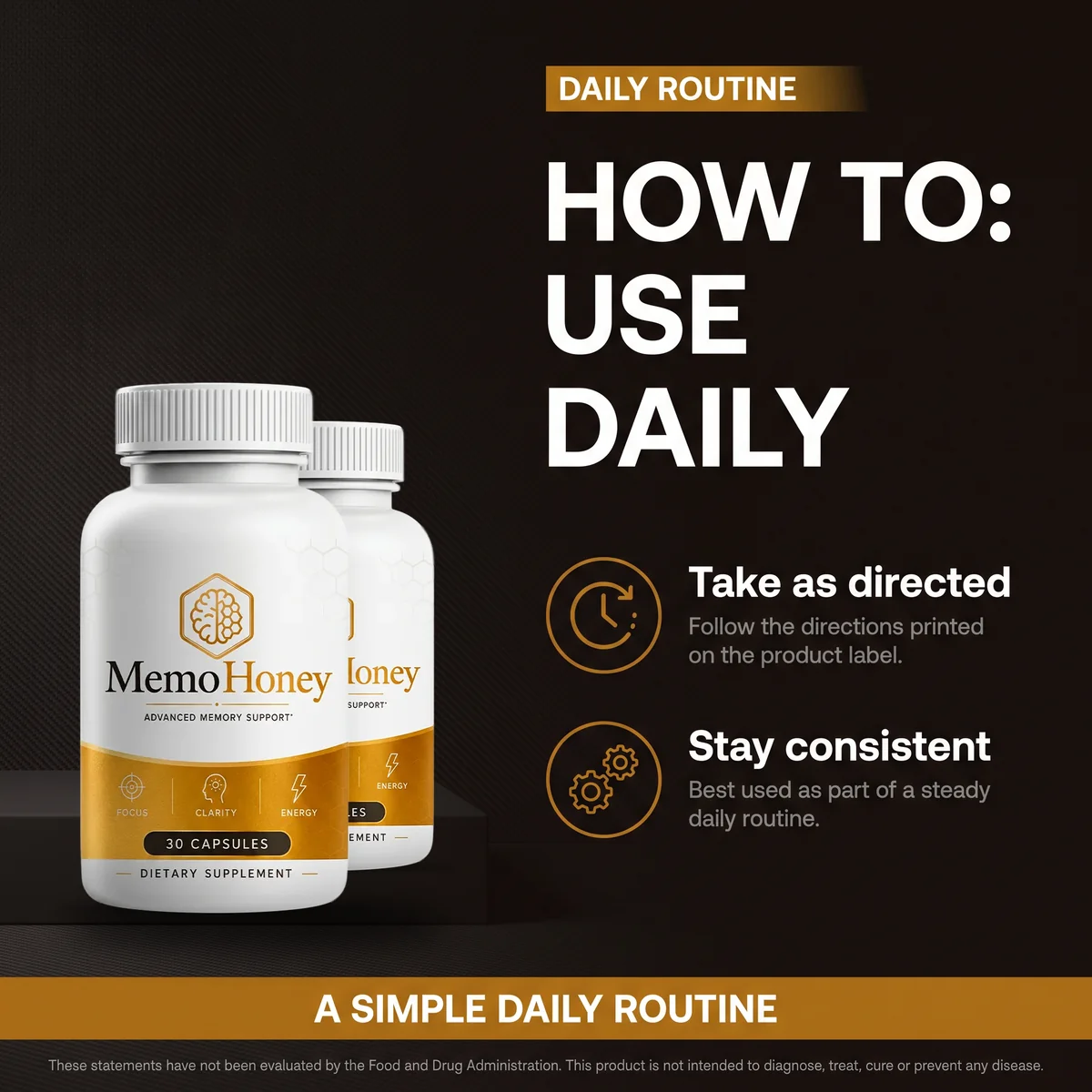
Start by reading serving size and directions together: one capsule daily with an 8 oz glass of water, 20 to 30 minutes before a meal, preferably in the morning. Then read the seven active lines and other ingredients. If you take medicines, write down the full list and take it to a pharmacist. A photo of the panel is far more useful in that conversation than remembering only the product name.
Next, separate questions a seller can answer from questions a clinician should answer. The seller can clarify current order terms, returns, and supplied documents. A pharmacist or prescribing clinician can consider blood-pressure medicines, nitrates, PDE5 inhibitors, and the rest of a person’s medication list. Memory changes that worry the person or family should be assessed rather than used as an online supplement experiment.
Finally, preserve the exact label rather than relying on a recap. The ingredients page gives the panel a full reading, and side effects describes the stated caution boundary. The right result of the seven-line comparison is not fear or certainty. It is a more complete record and fewer unsupported assumptions.
Read the MemoHoney label while this is in front of you
Seven lines on the label panel, the amount each published trial used beside them, and 60 days from the date of purchase to decide.
Two bottles $158 · six bottles $294 · 60-day money-back guarantee
Order MemoHoney From This CounterLot MEM-26/ME-4192 · one a morning, 30 to a bottle · ships from the United States
A final check before deciding
One final check prevents the usual supplement-label shortcut. Keep the source of each statement visible: the panel says what one capsule contains, the directions say how the seller tells a buyer to use it, the storage and caution lines say how the bottle should be handled, and the product copy states the seller’s support language. None of those sources is a personal diagnosis or a trial of the finished formula.
That does not make the printed facts useless. It makes them usable. A buyer can save the order record, photograph the panel, ask for a document when one is needed, and take medication or symptom questions to a pharmacist or clinician. The decision can then be based on what the product actually discloses rather than on a claim assembled from gaps in the label.
This method also makes a negative decision clear. If a needed amount, document, or service answer is not available, a buyer can simply leave the product unpurchased. That is not a failed research exercise. It is the normal result of comparing the information supplied with the information a person needs to decide responsibly.
- Read the serving size and the panel before the advertising ingredients list.
- Treat the seven panel lines as the full per-capsule statement supplied for this product.
- Use labelled amounts to identify differences from research, not to claim the research applies.
- Keep support language separate from disease treatment or personal medical advice.
- Bring the panel to a pharmacist when medicines or health conditions are involved.
MemoHoney is a dietary supplement rather than a treatment, and nothing here is medical advice. A memory change that other people have noticed, or one that has worsened steadily month on month, deserves an assessment rather than a purchase. MedlinePlus sets out what is worth reporting.
- Questions and Answers on Dietary Supplements. U.S. Food and Drug Administration. https://www.fda.gov/food/information-consumers-using-dietary-supplements/questions-and-answers-dietary-supplements
- Using Dietary Supplements Wisely. National Center for Complementary and Integrative Health, National Institutes of Health. https://www.nccih.nih.gov/health/using-dietary-supplements-wisely
- Li A, Li H, Chen J. The effects of L-citrulline supplementation on cerebrovascular function during sprint interval training in taekwondo athletes. J Exerc Sci Fit. 2025;23(3):222-228. PMID 40474881. https://pubmed.ncbi.nlm.nih.gov/40474881/
- Ostfeld I, Zamir A, Ben-Zeev T, et al. β-Alanine supplementation improves fractional anisotropy scores in the hippocampus and amygdala in 60-80-year-old men and women. Exp Gerontol. 2024;194:112513. PMID 38971131. https://pubmed.ncbi.nlm.nih.gov/38971131/
- Minto C, Vecchio MG, Lamprecht M, et al. Definition of a tolerable upper intake level of niacin: a systematic review and meta-analysis of the dose-dependent effects of nicotinamide and nicotinic acid supplementation. Nutr Rev. 2017;75(6):471-490. PMID 28541582. https://pubmed.ncbi.nlm.nih.gov/28541582/
- Memory. MedlinePlus, U.S. National Library of Medicine. https://medlineplus.gov/memory.html