MemoHoney Official Website › Articles › The routine
The routineMemoHoney Dosage: One Capsule, Before A Meal, The Only Timing Instruction You Get
The MemoHoney dosage is one capsule a day, taken with an 8 oz glass of water 20 to 30 minutes before a meal, preferably in the morning. The label’s caution block says not to exceed it, and taking two does not make anything happen sooner. One bottle holds 30 capsules, so it lasts a month. Before a meal matters because amino acids compete with dietary protein for the same intestinal transporters.
One line of directions, and what it is doing there
The whole instruction on this label runs to two sentences: take one capsule daily with an 8 oz glass of water, and for best results take it 20 to 30 minutes before a meal. The seller's page adds that the morning is best.
Most buyers read that as boilerplate and take the capsule whenever it is convenient. That is a reasonable thing to do and consistency matters more than timing. But the line is not boilerplate, and the reason it says before a meal rather than with one is specific to what is in the capsule.
This article is about the pharmacology behind one line of small print, and about the three things around the capsule that decide whether you can tell afterwards whether it did anything.
Treat what follows as reading about a dietary supplement, not as treatment advice. A memory change that other people have noticed, or one that has worsened steadily month on month, deserves an assessment rather than a purchase. MedlinePlus sets out what is worth reporting.
Why before a meal, and not with one
Amino acids do not simply diffuse across the intestinal wall. They are carried across by transporter proteins, and those transporters are shared: several amino acids compete for the same route.
Arginine and citrulline are both transported by systems that also carry the amino acids in dietary protein. A capsule swallowed in the middle of a breakfast containing eggs or yoghurt is competing with a large quantity of other amino acids for the same limited capacity. Swallowed on an empty stomach it is not.
That is the argument, and it is a real one rather than a marketing flourish. What it is not is dramatic. Nobody has run a trial of this product taken fasted against the same product taken with food, so the size of the difference is unknown. It costs nothing to follow, which is the strongest thing that can be said for it.
| Taken | The absorption argument | The practical argument |
|---|---|---|
| Fasted, first thing | Least competition for shared transporters | Easiest to attach to an existing routine |
| With a small breakfast | Some competition from dietary protein | Blunts a flush or a tingle, which at these amounts is unlikely anyway |
| With a large protein meal | Most competition | The one arrangement the label argues against |
| In the evening | No worse for absorption if taken fasted | Departs from the label, and nothing here disturbs sleep |
The middle column is pharmacology. The right-hand column is what most people actually decide on, and the two disagree in row two.
The one case for ignoring the instruction
If the capsule ever produces an uncomfortable flush, which is unlikely at the 7.5 mg of niacin the label prints, taking it with food blunts it by slowing absorption and lowering the peak concentration. That trades the absorption argument for comfort, and comfort usually wins, because a capsule that makes somebody uncomfortable is a capsule that stops being taken.
The same applies to beta-alanine paraesthesia, for the same reason. Neither effect is harmful, and the systematic risk assessment found no consistent adverse effect beyond the sensation itself at amounts far above the 40 mg on this label.
Consistency beats timing, by a wide margin
Here is the part of this subject that actually decides outcomes, and it has nothing to do with pharmacology.
A bottle holds 30 capsules. At one a day it should empty in a month. A bottle that takes six weeks to empty is telling you that it was taken on roughly twenty days out of thirty, and a twenty-day month is not a trial of anything.
The timeline on this product runs in weeks, not hours, which is why the distributor's own figure for when buyers notice anything is 3–6 weeks. Missed days do not simply delay that; they change what is being measured.
- Put the bottle where your hand already goes: the kettle, the toothbrush, the coffee tin
- Attach it to something that happens anyway, not to a time of day
- Keep it visible. A cupboard is where daily supplements go to be forgotten
- Count the capsules at the end of the first month. The number is the honest record of adherence

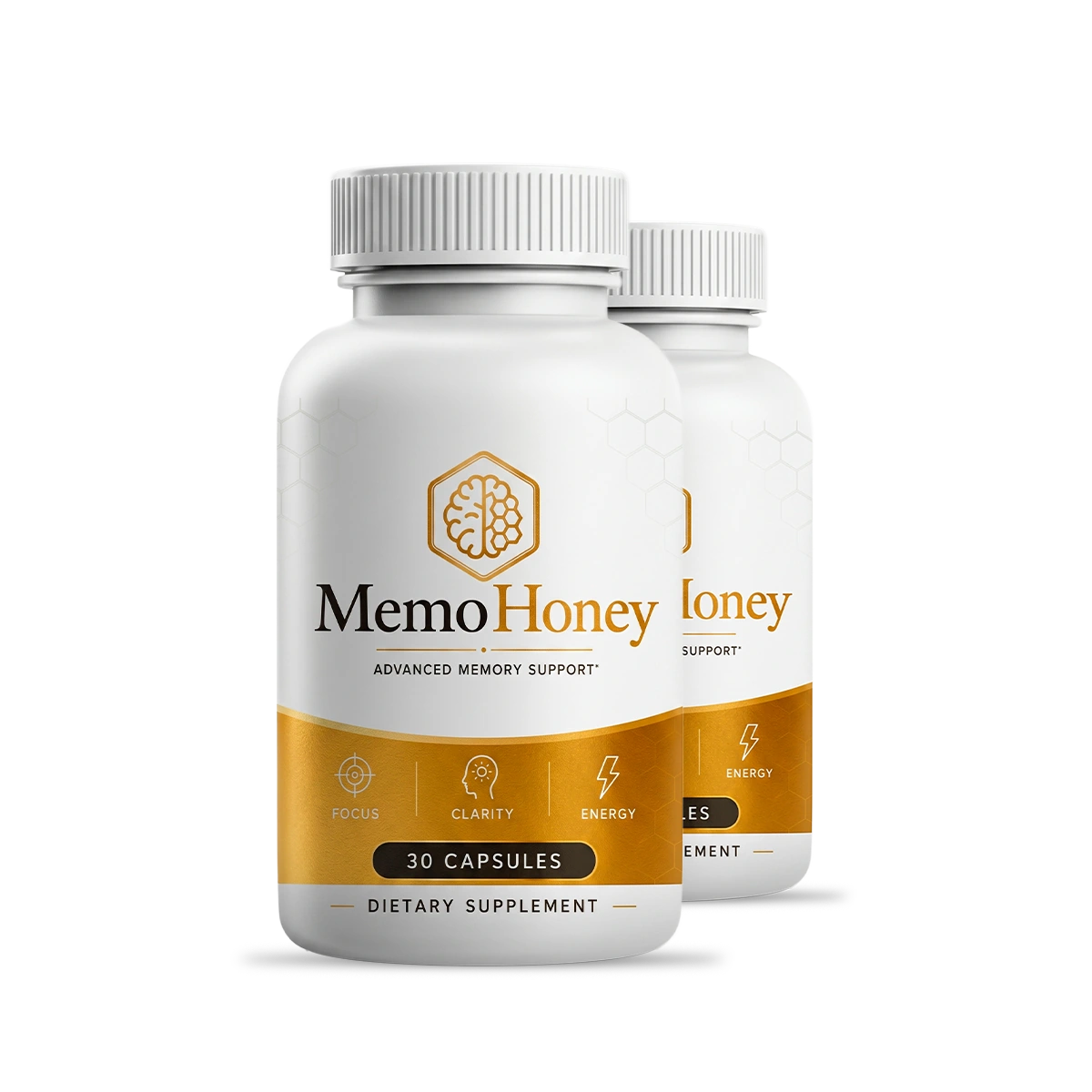
Read the MemoHoney label while this is in front of you
Seven lines on the label panel, the amount each published trial used beside them, and 60 days from the date of purchase to decide.
Two bottles $158 · six bottles $294 · 60-day money-back guarantee
Order MemoHoney From This CounterLot MEM-26/ME-4192 · one a morning, 30 to a bottle · ships from the United States
The three lines that make the sixty days worth something
The capsule is the easy part. The hard part is that the thing being measured is memory, and the instrument being used to measure it is also memory.
Comparing week eight against a recollection of week one is not a comparison. It is two impressions separated by two months, one of which was formed before anything started and neither of which was written down. The fix takes ninety seconds on day one.
- How you slept last night, in one word. Sleep is the single largest confounder in this whole category and it moves week to week
- How the late afternoon felt, in one word. It is the time of day people actually notice a difference in, if they notice one
- One concrete thing you keep mislaying or forgetting. Keys, names, why you walked into the room. Something countable rather than a feeling
Then write two words a morning for the rest of the bottle, and read the lot back at day 40. Not day 60: the refund window closes 60 days after the date of purchase, transit came out of that, and a return still has to travel.
Day 40 is the last comfortable decision point, and it is late enough that the first-fortnight effect of having started something new has faded. That effect is real, it happens to almost everybody, and it is the single commonest reason people conclude a supplement worked when nothing did.
The first fortnight, and the effect that is not the capsule
Something happens to almost everybody in the first two weeks of starting a supplement, and it is not the supplement.
Beginning a new daily routine you chose and paid for produces a genuine improvement in how people rate their own functioning. Attention to attention is itself a change: somebody who has started noticing whether they remember things remembers more of them, at least at first. Add the ordinary expectation effect that follows any purchase and the first fortnight is the least informative stretch of the whole trial.
It also fades. That is the important part, and it is why the decision point on this site is day 40 rather than day 14.
Why that matters more on this product than on most
Nothing on this label acts quickly, and at the milligram amounts it prints nothing is likely to act dramatically at all. The distributor's own figure for when buyers notice anything is 3–6 weeks, and the reviewer roster bears that out: every five-star entry in it was written at day 40 or later, and every lower-scored entry carries the same sentence about week one.
So the two effects run in opposite directions. The novelty effect is strongest when the product is doing least, and weakest by the time the product could plausibly be doing anything. Judging at day 14 measures one; judging at day 40 measures the other.
- Write the baseline before the first capsule, not after the first week
- Count something rather than rating a feeling
- Change one thing at a time. A new capsule and a new bedtime produce an unreadable result
- Do not read the notes back until day 40
Two things the label deliberately does not cover
A single sentence of directions leaves a good deal unsaid, and two of the gaps come up often enough to answer here.
The first is what to do about a missed day. The label is silent, and the sensible answer follows from the pharmacology rather than from the bottle. Carry on at the usual hour tomorrow and leave the missed one missed: nothing in this formula accumulates quickly enough for a single gap to matter, and two capsules at once is exactly what the label's caution rules out: do not exceed the recommended dose.
The second is whether to stop. There is no taper on this label, no loading period and no cycling schedule, and none is invented here. Nothing in the formula builds tolerance the way a stimulant does, so a bottle simply finishes and either another one starts or it does not.
The short version
- The label's instruction is one capsule with an 8 oz glass of water, 20 to 30 minutes before a meal; the seller adds the morning
- Before a meal is a real argument: amino acids compete with dietary protein for shared transporters
- Nobody has trialled this product fasted against fed, so the size of the difference is unknown
- Taking it with food is a reasonable trade if the capsule ever disagrees with you
- Consistency matters more than timing, and a bottle that lasts six weeks is a record of adherence
- Three lines written on day one and a decision at day 40 is what turns sixty days into an answer
- Am J Clin Nutr (2013) 97(5):972-9: “Kinetics of the utilization of dietary arginine for nitric oxide and urea synthesis: insight into the arginine-nitric oxide metabolic system in humans”, by Mariotti F, Petzke KJ, Bonnet D, et al, PubMed 23535108.
- Am J Physiol Gastrointest Liver Physiol (2007) 293(5):G1061-7: “Manipulation of citrulline availability in humans”, by Rougé C, Des Robert C, Robins A, et al, PubMed 17901164.
- Adv Nutr (2019) 10(3):452-463: “A Systematic Risk Assessment and Meta-Analysis on the Use of Oral β-Alanine Supplementation”, by Dolan E, Swinton PA, Painelli VS, et al, PubMed 30980076.
- Nutr Rev (2017) 75(6):471-490: “Definition of a tolerable upper intake level of niacin: a systematic review and meta-analysis of the dose-dependent effects of nicotinamide and nicotinic acid supplementation”, by Minto C, Vecchio MG, Lamprecht M, et al, PubMed 28541582.
- MedlinePlus, US National Library of Medicine (medlineplus.gov): “Memory”.