MemoHoney Official Website › Articles › The mechanism
The mechanismNitric Oxide And Memory: What Widening A Blood Vessel Can And Cannot Do
The argument behind an amino-acid memory label is a plumbing argument, not a chemistry one.
Arginine becomes nitric oxide, nitric oxide widens blood vessels, and better-supplied tissue is said to work better. Every link in that chain is settled physiology except the last one, and the last one is the whole proposition.
The claim underneath a memory label
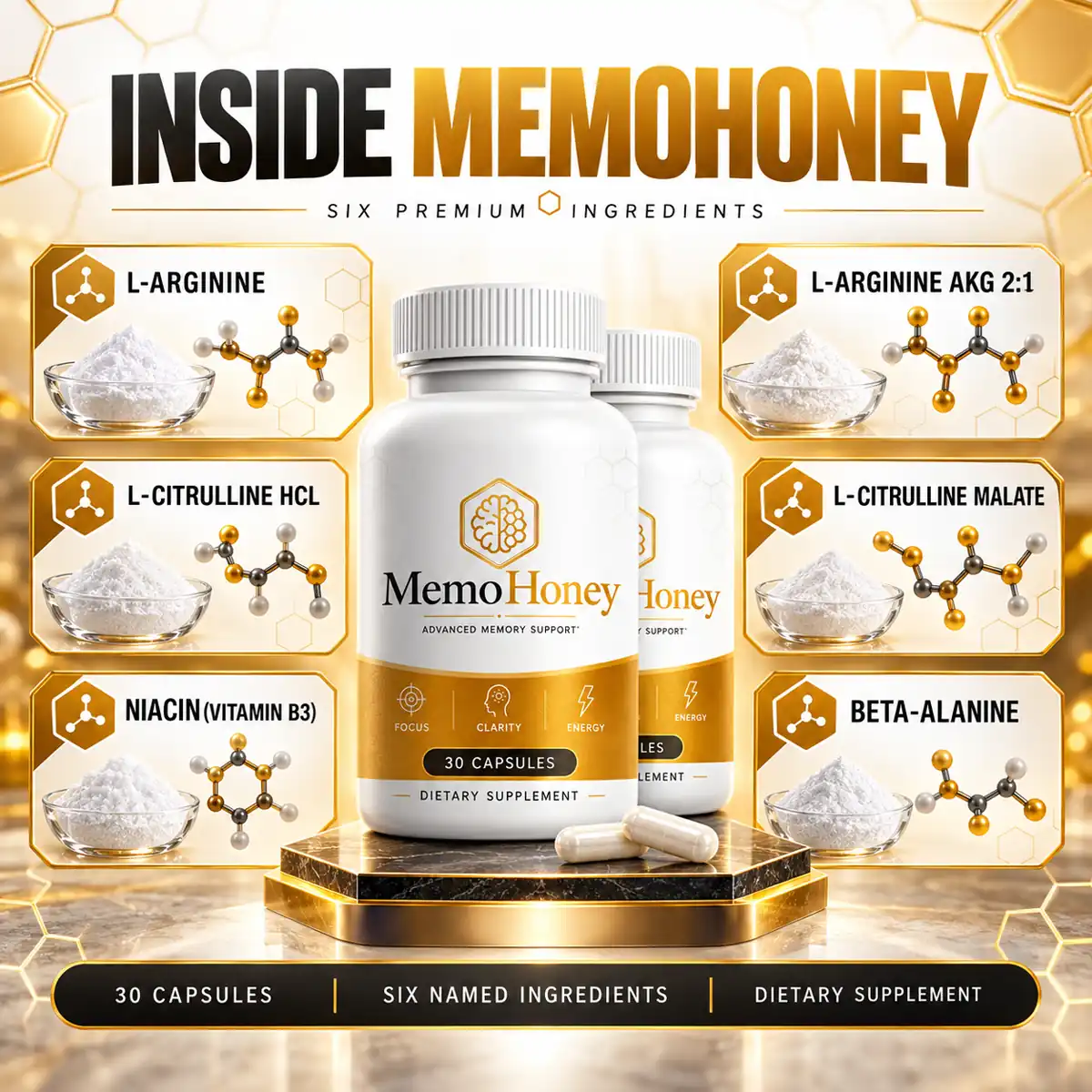
Read the ingredient list on a bottle like this one and the first surprise is how little of it looks like a brain product. Four of the seven lines on its panel are arginine and citrulline forms out of the sports-nutrition aisle, and the argument that puts them on a memory label is a plumbing argument rather than a chemistry one.
The chain runs like this. An enzyme converts arginine into nitric oxide. Nitric oxide relaxes the ring of muscle around a blood vessel. A relaxed vessel is a wider vessel. A wider vessel carries more blood. Tissue supplied with more blood works better. The brain is tissue.
Every link in that chain except the last one is settled physiology. The last one is where a supplement label becomes a hypothesis, and this article is about how far along the chain the evidence actually goes.
Treat what follows as reading about a dietary supplement, not as treatment advice. A memory change that other people have noticed, or one that has worsened steadily month on month, deserves an assessment rather than a purchase. MedlinePlus sets out what is worth reporting.
Why the label carries two molecules, not one
The first problem in this whole category is that swallowed arginine mostly does not arrive. An enzyme called arginase in the gut wall and the liver breaks down a large share of an oral dose before it reaches the general circulation, which is what the stable-isotope work on dietary arginine set out to quantify.
Citrulline is the workaround, and it is an elegant one. It is absorbed intact, passes the liver without being stripped, and is converted to arginine in the kidney. Gram for gram it raises blood arginine more reliably than arginine does, which a human availability study measured directly and a 2026 quantitative characterisation traced step by step.
Carrying both forms on one label is therefore not padding. It is covering the direct substrate and the more efficient precursor at the same time, and there is even a trial of the two given together showing the pair raises plasma levels faster than either alone.
| The molecule | How it gets to nitric oxide | The catch |
|---|---|---|
| L-Arginine | Directly. It is the enzyme's only substrate | Most of an oral dose is broken down before it arrives |
| L-Arginine AKG 2:1 | As arginine, from a salt said to survive better | Its own trial used 12 g a day, split three ways |
| L-Citrulline HCl | Absorbed intact, converted at the kidney | Trials run at 3 to 12 g a day |
| L-Citrulline Malate | The same, on malic acid instead | The sports form. Same gram-scale amounts |
Four rows, one pathway. The differences are about delivery rather than about what the amino acid does once it is there. The label prints 200 mg of each arginine line and 100 mg of each citrulline line.
What more blood flow actually buys
Here is where the chain gets interesting, because the middle links are genuinely well measured.
Blood pressure is the outcome with the most data behind it. A 2019 review of oral arginine and citrulline and a 2025 meta-analysis of citrulline and watermelon intake both report modest reductions in systolic pressure. Modest is the right word: these are effects of a few millimetres of mercury, not a replacement for medication, and they were produced by several grams a day.
Exercise is the other well-trodden outcome. Three days of citrulline malate at 8 g a day changed repeated-sprint performance; a head-to-head comparison of 8 g and 12 g looked at what more buys. An older-adult trial at 3 g a day improved lower-limb function alongside six weeks of supervised exercise, which is the closest any of this comes to an ordinary person's life.
The one measurement taken in the right organ
There is exactly one study in this whole cast that measured anything inside the skull. A 2025 trial published in the Journal of Exercise Science and Fitness gave L-citrulline at 8.8 g a day for five days and measured cerebrovascular function during sprint interval training.
It found an effect. That is a real result and it deserves to be said plainly rather than buried.
Three things sit alongside it. The participants were trained, not people complaining about names. The measurement was taken during hard exercise, not at a desk. And 8.8 g a day is forty-four times the 200 mg of citrulline this label prints across its two citrulline lines.
The link nobody has closed
Blood flow is measurable. Memory is measurable. The step between them is the whole proposition of this category, and almost nobody has measured both in the same people at the same time.
What makes that gap easy to overlook is that every individual claim in the chain is true. Nitric oxide does dilate vessels. Dilated vessels do carry more blood. Brain tissue does depend on perfusion. A reader who checks each statement separately will find each one supported, and will still have learned nothing about whether a capsule improves recall.
The honest position is that this is a plausible mechanism with an untested conclusion. Plausible is not nothing: it is the reason the research is worth doing. It is also not a result.
- Supported: citrulline raises plasma arginine more reliably than arginine
- Supported: gram-scale amounts lower systolic blood pressure modestly
- Supported: one trial measured cerebral blood flow during exercise
- Not established: that raising blood flow improves memory in anyone
- Not established: any effect at the 400 mg of arginine and 200 mg of citrulline this label prints
Read the MemoHoney label while this is in front of you
Seven lines on the label panel, the amount each published trial used beside them, and 60 days from the date of purchase to decide.
Two bottles $158 · six bottles $294 · 60-day money-back guarantee
Order MemoHoney From This CounterLot MEM-26/ME-4192 · one a morning, 30 to a bottle · ships from the United States
What a reader should do with all this
Three practical conclusions follow, and none of them is that the mechanism is nonsense.
First, treat the blood-pressure literature as the interaction warning it is. Four ingredients on this label feed a pathway that nitrates, blood-pressure medicines and erectile-dysfunction drugs also act on. Modest effects matter when something else is already producing them, and one sentence at a pharmacy counter settles it.
Second, do not buy the capsule expecting the citrulline trial's result. That trial used 8.8 g a day; the label prints 200 mg. Reading the amount a study used, beside the amount on the label it is being sold in, is the single most useful habit in this whole category.
Third, judge it on its own terms and over its own timescale. Nothing in a nitric-oxide formula produces a same-day effect you could notice, so a week is not a trial. The distributor's own figure is 3–6 weeks.
The trials that found nothing, and why they matter more
A category is best judged on its negative results, because those are the ones nobody quotes. This pathway has several and they are worth knowing.
A randomised trial of arginine AKG gave 3,000 mg before a single training session and found no improvement in muscular performance. A second trial ran seven days at 12 g a day and measured blood flow and plasma arginine directly; it reported no meaningful change in either. A third gave arginine AKG twice, at 3,700 mg a serving, and found no effect on muscle endurance or blood pressure.
Those are three separate failures for the salt form specifically, one of them at the full 12 g daily amount its own pharmacokinetic work used. That is not a reason to conclude the ingredient does nothing; it is a reason to be careful about what it has been shown to do.
What a null result actually tells you
A trial that finds nothing can mean several different things, and separating them is most of the skill in reading this literature.
It can mean the ingredient does not work. It can mean the amount was too small, or the trial too short, or the participants already replete. It can mean the outcome measured was the wrong one: a study looking for a sprint improvement would not detect a change in recall even if one happened.
What it cannot mean is nothing at all. Three null trials of one salt form, at amounts from 3 g to 12 g a day, are evidence about the ceiling, and this label's 200 mg of arginine AKG is a fifteenth of the lowest of them.
| The trial | What it gave | What it measured | Result |
|---|---|---|---|
| Acute AKG supplementation | 3,000 mg, once before a session | Muscular performance | No effect |
| Seven days of AKG | 12 g a day | Blood flow and plasma arginine | No meaningful change |
| Acute arginine supplementation | 3,700 mg, twice | Muscle endurance and blood pressure | No improvement |
| Citrulline and cerebrovascular function | 8.8 g a day for five days | Cerebral blood flow during sprint intervals | An effect |
Three nulls and one positive, all at fifteen to sixty times the amounts on this label. The positive one is the only measurement taken inside the skull.
The short version
- The argument behind this label is circulatory: more nitric oxide, wider vessels, better-supplied tissue
- Two molecules appear in four forms because oral arginine is largely destroyed before it arrives and citrulline is not
- Blood pressure and exercise outcomes are well measured at gram-scale amounts; the label prints milligrams
- One trial measured cerebral blood flow, in athletes, during sprint intervals, at 8.8 g a day
- The step from blood flow to memory has not been tested in this or any similar product
- The practical consequences are an interaction to raise, an expectation to lower and a timescale of weeks
- Am J Clin Nutr (2013) 97(5):972-9: “Kinetics of the utilization of dietary arginine for nitric oxide and urea synthesis: insight into the arginine-nitric oxide metabolic system in humans”, by Mariotti F, Petzke KJ, Bonnet D, et al, PubMed 23535108.
- Am J Physiol Gastrointest Liver Physiol (2007) 293(5):G1061-7: “Manipulation of citrulline availability in humans”, by Rougé C, Des Robert C, Robins A, et al, PubMed 17901164.
- Front Pharmacol (2026) 17:1889835: “Quantitative characterization of L-citrulline as a precursor of L-arginine in rats: pharmacokinetic basis for nitric oxide-mediated effects”, by Song S, Thapa SK, Upadhyay M, et al, PubMed 42755674.
- Biochem Biophys Res Commun (2014) 454(1):53-7: “Oral supplementation with a combination of L-citrulline and L-arginine rapidly increases plasma L-arginine concentration and enhances NO bioavailability”, by Morita M, Hayashi T, Ochiai M, et al, PubMed 25445598.
- Nutrients (2019) 11(7):1679: “The Effects of Oral l-Arginine and l-Citrulline Supplementation on Blood Pressure”, by Khalaf D, Krüger M, Wehland M, et al, PubMed 31336573.
- Clin Nutr ESPEN (2025) 69:653-664: “Does l-citrulline supplementation and watermelon intake reduce blood pressure in middle-aged and older adults? A systematic review and meta-analysis of randomized controlled trials”, by Luo P, Chen J, Liu K, et al, PubMed 40789388.
- Eur J Sport Sci (2024) 24(6):758-765: “Effects of 3 days of citrulline malate supplementation on short-duration repeated sprint running performance in male team sport athletes”, by Faria VS, Egan B, PubMed 38874989.
- J Funct Morphol Kinesiol (2026) 11(1): “The Comparative Effect of Acute Moderate- and High-Dose Citrulline Malate on Resistance Exercise Performance in Trained Individuals: A Double-Blind Randomised Controlled Pilot Trial”, by Gough LA, Tan R, Bailey SJ, et al, PubMed 41900522.
- Clin Nutr ESPEN (2026) 74:103356: “Short-term citrulline malate supplementation enhances lower-limb function in physically active older women: A pilot randomized controlled trial”, by Ramos-Hernández R, Pascual-Fernández J, Álvarez-Pardo S, et al, PubMed 42162613.
- J Exerc Sci Fit (2025) 23(3):222-228: “The effects of L-citrulline supplementation on cerebrovascular function during sprint interval training in taekwondo athletes”, by Li A, Li H, Chen J, PubMed 40474881.
- J Int Soc Sports Nutr (2012) 9(1):17: “Acute L-arginine alpha ketoglutarate supplementation fails to improve muscular performance in resistance trained and untrained men”, by Wax B, Kavazis AN, Webb HE, et al, PubMed 22510253.
- Int J Sport Nutr Exerc Metab (2011) 21(4):291-9: “Effects of 7 days of arginine-alpha-ketoglutarate supplementation on blood flow, plasma L-arginine, nitric oxide metabolites, and asymmetric dimethyl arginine after resistance exercise”, by Willoughby DS, Boucher T, Reid J, et al, PubMed 21813912.
- J Strength Cond Res (2011) 25(7):1789-94: “Acute arginine supplementation fails to improve muscle endurance or affect blood pressure responses to resistance training”, by Greer BK, Jones BT, PubMed 21399536.
- MedlinePlus, US National Library of Medicine (medlineplus.gov): “Memory”.